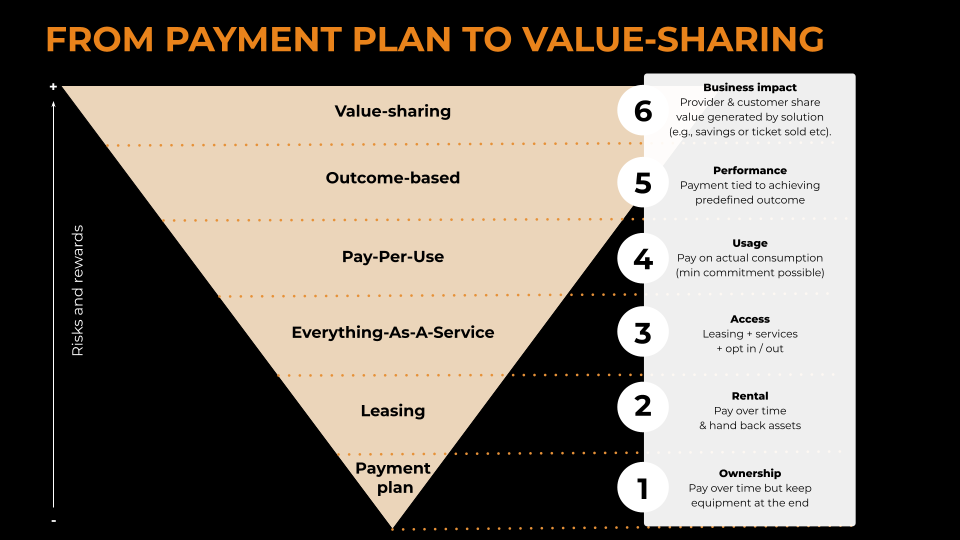
Manufacturers have little doubt about the importance of services anymore. The question is how far they are actually prepared to change the economics of their business.
BCG's 2025 benchmark of industrial manufacturers found that companies prioritising aftermarket services generate a third or more of their income from them, with service gross margins of around 42%. Yet the same research found that only 4% had succeeded in generating recurring revenue from digital services linked to their equipment.
That gap is telling.
Manufacturers are getting better at selling services around their assets. But when customers start asking for more flexibility, different ways to pay or even guaranteed outcomes, there is a much broader spectrum of commercial models to consider.
Leasing is an obvious one.
It provides recurring payments. It removes the customer's upfront CAPEX. Ownership can remain with the manufacturer or move to a financing partner. Maintenance can be bundled into the contract. And for many customer needs, it can be exactly the right answer.
Leasing is usually the starting point. But other economic models can be better suited.
Leasing and pay-per-use price different things
Suppose a manufacturer has a machine worth €500,000.
They can sell that machine outright. Or they can structure a five-year lease, with the customer paying a fixed amount each month. There are financing costs, residual-value assumptions and service costs to consider, but the revenue profile is largely known when the contract is signed.
Now suppose the customer doesn't want a fixed payment for the machine. He wants to pay €100 for every hour the machine operates.
The economics have changed.
At 4,000 hours a year, the contract could be highly profitable. At 2,500, the return might still be acceptable. At 1,200, the manufacturer may struggle to cover depreciation, financing and the fixed infrastructure required to support the asset.
Neither model is inherently better. They simply allocate uncertainty differently.
With a fixed lease, the customer avoids the upfront CAPEX and gains predictable payments, while generally retaining the economic consequences of how much or how little it uses the asset.
With pay-per-use, some of that variability moves to the provider.
The customer is effectively saying: we don't know how much capacity we will need, and we don't want to pay for capacity we don't use.
That flexibility has an economic value.
If utilisation falls by 40%, revenue falls with it, but depreciation and financing costs don't. The service organisation still exists. Some maintenance costs decline, but others are time-based. And if the equipment is highly specialised, moving it to another customer may be difficult.
The provider has effectively given the customer an economic hedge against underutilisation.
Was that hedge included in the price?
A manufacturer might require a minimum usage commitment, price utilisation bands differently, charge for reserved capacity as well as actual usage, or accept more utilisation risk because its fleet is large enough to redeploy assets.
There is no universally correct structure. But there should be a deliberate one.
Recurring revenue doesn't tell you which model you have
The attraction of recurring revenue is understandable.
Now, imagine two machines each producing €10,000 of monthly recurring revenue.
The first is operating close to full utilisation, has predictable maintenance costs and can readily be redeployed at the end of the contract.
The second is underutilised, requires more field service than forecast and was designed so specifically for the customer that there is little secondary demand.
The ARR is identical. The economics aren't.
Manufacturers therefore need to look below recurring revenue and contract value and understand the economics of the specific model they are offering.
Depending on that model, asset utilisation, lifetime contribution, cost-to-serve, capital employed, residual value and downside exposure can matter just as much as the recurring revenue itself.
Growth can otherwise hide the problem. Every new contract adds recurring revenue, but if the provider retains ownership it may also require another asset to be financed before most of that revenue arrives. And if revenue is linked to usage or outcomes, the provider may also be taking on variability that doesn't exist in a conventional fixed-payment structure.
Financing has to follow the commercial model
Different commercial models also require different financing structures.
A financing partner can readily understand an asset backed by a five-year contract with fixed monthly payments.
Move to a contract where payments depend on machine hours, production volumes or performance and the conversation changes.
Who carries the shortfall if utilisation drops? Who takes the residual-value risk? What happens if the customer terminates early? Can the equipment be redeployed, and who bears the cost while it is between customers?
Those questions need to be answered as the commercial model is designed, not afterwards.
Sometimes a traditional leasing structure will be the right answer. Sometimes the risks need to be separated differently. A financing partner can carry the capital and credit risk. The manufacturer can retain technical-performance risk because it can influence reliability and maintenance. The customer can keep part of the utilisation risk through a minimum commitment.
The objective isn't to transfer every possible risk to the manufacturer. It is to put each risk with the party best able to control, diversify or finance it.
The commercial conversation has to reflect the model
Selling a lease is comparatively straightforward. The conversation remains close to the asset: here is the machine, here is what it does, and here is the monthly payment instead of the purchase price.
Selling usage or outcomes requires a different conversation.
If the customer pays per hour, what is an hour worth to them? If it pays per unit produced, which variables determine output? If the manufacturer guarantees availability, where does its responsibility end when the customer's own processes cause downtime?
The commercial team has to understand not only the equipment but the customer's economics around it.
IFS and Accenture surveyed 800 senior manufacturing leaders and found that 94% said new service models had already affected their operations, with 39% describing them as central to long-term growth.
Yet BCG's finding that only 4% of industrial manufacturers in its benchmark have successfully created recurring revenue from equipment-linked digital services suggests how difficult monetisation remains.
So when is leasing actually the right answer?
Quite often.
If the customer's problem is primarily CAPEX, a lease can solve it elegantly. If the customer wants predictable costs and expects stable utilisation, introducing variable pricing may add complexity without creating meaningful value.
But a customer asking for "flexibility" can mean several different things.
They may want to avoid an upfront investment. They may want payments to fall when production falls. They may want guaranteed equipment availability. Or they may no longer want responsibility for operating the equipment at all.
Those requirements lead to different commercial models.
So rather than starting with “Should we offer leasing or As-A-Service?”, manufacturers can ask something more useful:
What does our customer actually want to pay for, which uncertainty do they no longer want to own, and who is best placed to carry it?
If the answer is utilisation, price utilisation risk.
If it is uptime, understand the cost and probability of downtime.
If it is asset ownership, structure the financing accordingly.
If it is simply CAPEX, a lease may be exactly the right answer.
The opportunity isn't about replacing leasing with As-A-Service. It is about understanding the range of commercial models available and recognising that, although they can look similar from the outside, their underlying economics can be fundamentally different.
Leasing feels safe because its economics are familiar and relatively predictable.
Sometimes that is exactly what the customer, and the manufacturer, needs.
The problem is when that familiarity stops us asking whether the customer's need calls for something different.