For years, many industrial companies have viewed servitization as a simple progression: first offer financing, then leasing, then Product-As-A-Service (PaaS). While this evolution is directionally correct, it only tells part of the story.
The real transformation is no longer about changing how customers pay, but about changing what customers pay for.
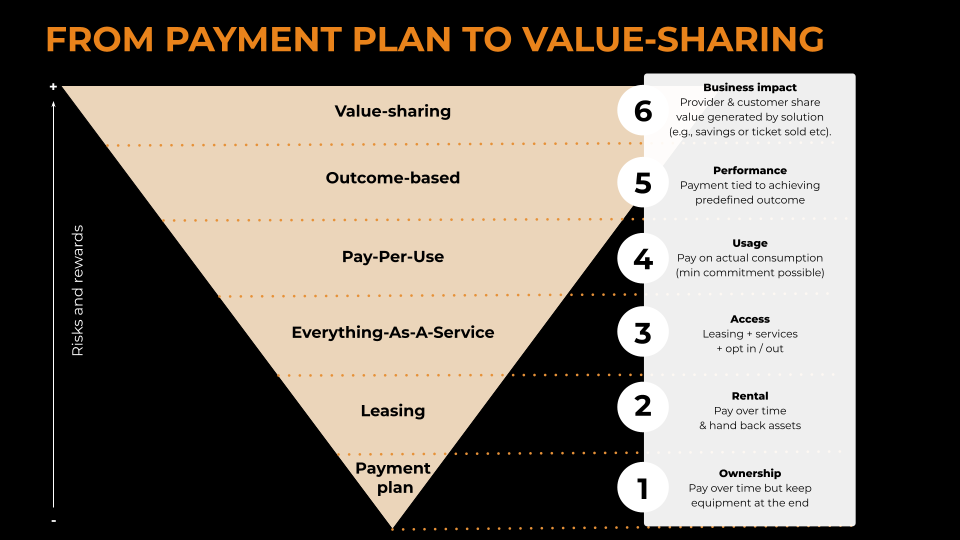
As manufacturers continue shifting from transactional sales to recurring revenue models, the most successful companies are moving beyond PaaS toward outcome-based and value-sharing models. The journey can be visualized as an inverted triangle, where risks and rewards are increasingly shared between provider and customer.
The PaaS maturity journey
At Black Winch, we often describe the evolution of industrial business models as a progression through six levels.
1. Payment plans: Making ownership more accessible
At the base of the pyramid sits the traditional payment plan.
Customers purchase the equipment and ultimately own it. The only change is that payment is spread over time instead of being made upfront.
The supplier's business model remains largely unchanged:
- Revenue is still tied to the product sale
- Risk remains mostly with the customer
- Customer value is linked to asset ownership
While payment plans can improve affordability, they do not fundamentally transform the customer relationship.
2. Leasing: paying for access
The next step is leasing.
Instead of purchasing equipment, customers pay for the right to use it for a defined period and can return the asset at the end of the contract.
This shifts the conversation from ownership to access.
Benefits include:
- Lower upfront investment
- Greater flexibility
- Easier technology upgrades
- Reduced asset ownership risk
For manufacturers, leasing creates recurring revenue streams but still focuses primarily on asset availability rather than business outcomes.
3. Product-As-A-Service (PaaS): access + services
This is where many industrial companies begin their servitization journey.
Product-As-A-Service combines equipment access with a bundle of supporting services, such as:
- Maintenance
- Repairs
- Monitoring
- Software updates
- Operator support
- Performance reporting
Instead of buying a machine, customers subscribe to a solution that keeps the machine operational.
The focus shifts from the asset itself to ensuring its continuous availability and performance.
What makes PaaS different?
Unlike leasing, PaaS introduces a stronger partnership between provider and customer.
The manufacturer remains involved throughout the asset lifecycle and often retains ownership of the equipment.
This creates several advantages:
- Predictable recurring revenue
- Stronger customer retention
- Better lifecycle management
- Increased opportunities for digital services
- Improved sustainability through asset circularity
For customers, PaaS reduces operational complexity while improving budget predictability.
However, despite these benefits, most PaaS models still charge customers through fixed subscriptions or contracted fees.
And this is where the next evolution begins.
4. Moving beyond PaaS: Pay-Per-Use (PPU)
Many industrial companies discover that customers are not primarily interested in equipment availability.
They are interested in using the equipment when needed.
This realization leads to Pay-Per-Use models.
Instead of paying a fixed monthly fee, customers pay according to actual consumption.
Examples include:
- Per operating hour
- Per production cycle
- Per ton processed
- Per kilometre travelled
- Per scan completed
- Per printed unit
The key difference is simple:
Customers only pay when value is being consumed.
Why customers like Pay-Per-Use
Pay-Per-Use aligns costs with business activity.
During slow periods, costs decrease.
During growth periods, capacity can scale without major capital investments.
For many customers, this creates a lower-risk adoption path for new technologies.
Why providers like Pay-Per-Use
For manufacturers, Pay-Per-Use creates opportunities to:
- Capture more customer value over time
- Increase equipment utilization
- Gain operational data insights
- Differentiate from competitors
- Build stronger long-term relationships
However, providers also assume more risk because revenues become linked to customer usage levels.
This is where digital capabilities become essential.
Accurate usage tracking, connectivity, billing automation, and data analytics are critical foundations for scaling Pay-Per-Use successfully.
5. Outcome-based models
As industrial companies mature in their PaaS journey, they begin asking a different question:
What if customers paid for the result instead of the usage?
This is the essence of outcome-based business models.
Rather than charging per hour or per unit consumed, providers are compensated when predefined outcomes are achieved.
Examples include:
- Guaranteed machine uptime
- Energy savings delivered
- Production output achieved
- Product quality improvements
- Reduction in downtime
- Increased throughput
The customer is no longer buying equipment access or usage.
They are buying a business result.
Why outcome-based models are growing
Several trends are accelerating adoption:
- Increased availability of IoT data
- Better predictive analytics
- Real-time monitoring capabilities
- Greater pressure on customers to improve productivity
Outcome-based contracts align incentives between supplier and customer more closely than any previous model.
Both parties win when performance improves.
6. Beyond outcome-based: value-sharing
At the top of the maturity curve sits the most advanced model: value-sharing.
In this model, payment is directly linked to the value generated by the solution.
Instead of charging for usage or even a predefined outcome, the provider receives a share of the economic benefit created.
Examples include:
- Sharing energy savings achieved
- Sharing productivity gains
- Sharing revenue generated
- Sharing cost reductions
- Sharing profits from improved operations
This creates the strongest possible alignment between provider and customer.
The supplier is no longer simply delivering equipment or services.
They become a strategic partner invested in the customer's success.
Why value-sharing is difficult
Despite its attractiveness, value-sharing requires significant maturity.
Companies need:
- Strong trust between parties
- Transparent data access
- Agreed value measurement methods
- Advanced analytics capabilities
- Robust contractual frameworks
Not every organization is ready for this level of partnership.
But for companies that achieve it, value-sharing can create powerful competitive differentiation and significantly higher long-term value creation.
How to move beyond PaaS
Some companies are still exploring leasing. Others are launching their first Product-As-A-Service (PaaS), Software-As-A-Service (SaaS) or Everything-As-A-Service (XaaS) offering. A growing number are experimenting with Pay-Per-Use, outcome-based contracts, or even value-sharing agreements.
The important thing is not to jump directly to the top of the pyramid. Successful transitions happen gradually.
Each stage requires new capabilities, from asset lifecycle management and usage tracking to performance measurement and value quantification.
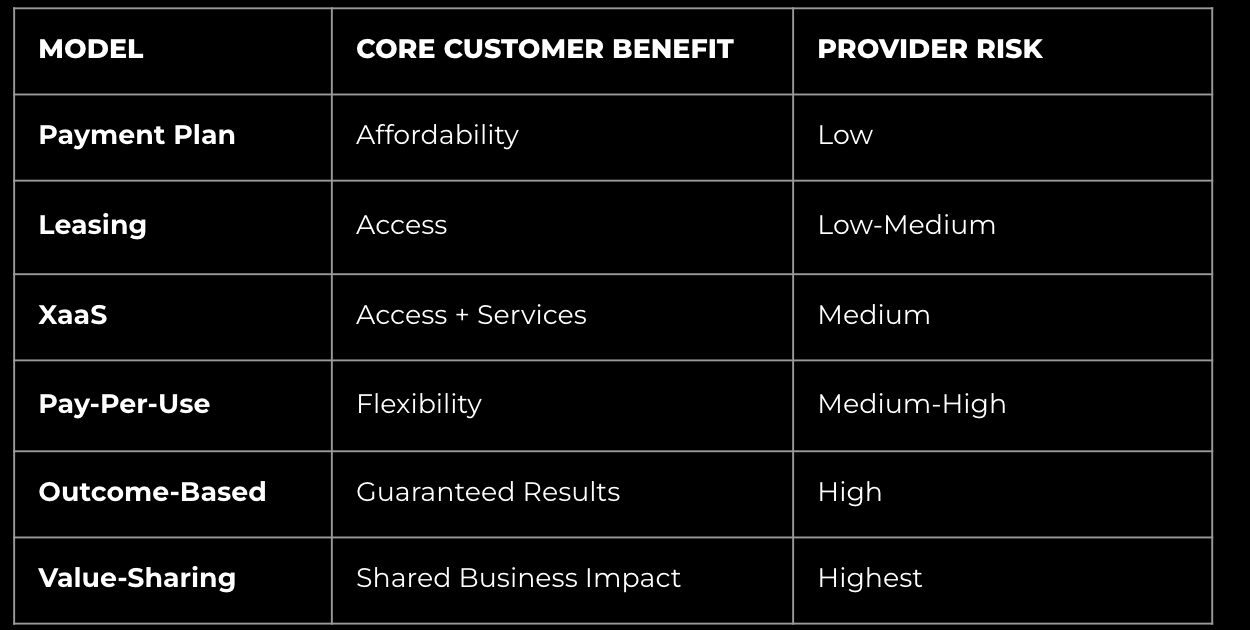
As companies move up the inverted pyramid, both risks and rewards increase.
The critical question is not:
"Which model is best?"
The real question is:
"Which model matches the value you create and the capabilities you can support?"
The answer will determine not only how you monetize your offering, but also how differentiated, resilient, and profitable your business can become.
Real-world examples of moving beyond PaaS
Many leading industrial companies have already demonstrated what this evolution looks like in practice.
- Michelin: From selling tires to selling kilometres
One of the most cited industrial examples is Michelin's transformation from a tire manufacturer into a mobility solutions provider.
Instead of selling tires outright, Michelin introduced a Tire-As-A-Service model where fleet operators pay according to the distance travelled. The company remains responsible for tire performance, maintenance, monitoring and optimization. Today, Michelin manages hundreds of thousands of vehicles under usage-based contracts and generates significant recurring revenue through these services.
This model illustrates the evolution from:
Product sale → Service contract → Pay-per-use
What customers buy is no longer the tire itself, but reliable mobility and predictable operating costs.
Michelin has continued expanding this approach through connected mobility services, predictive maintenance and fleet optimization solutions that help customers reduce downtime and improve operational performance.
Listen to our podcast for more insights.
- Rolls-Royce: The pioneer of outcome-based contracts
Long before "PaaS" became a buzzword, Rolls-Royce introduced its famous Power-by-the-Hour model for aircraft engines.
Instead of charging airlines for engine ownership and maintenance separately, Rolls-Royce charges based on engine operating hours while committing to performance and availability targets.
The airline pays for propulsion capability rather than the physical asset.
- Signify (Philips): Selling light instead of lamps
Signify, formerly Philips Lighting, pioneered the concept of Light-As-A-Service.
Customers no longer purchase lighting infrastructure. Instead, they pay for lighting performance while Signify retains ownership and responsibility for maintenance, upgrades and energy efficiency.
The model aligns incentives perfectly:
- Customers receive guaranteed lighting performance.
- Signify benefits from maximizing asset lifespan and energy efficiency.
- Both parties share an interest in reducing waste and operating costs.
- Kaeser Compressors: Compressed Air As A Service
German compressor manufacturer Kaeser shifted from selling compressors to providing compressed air on demand.
Customers pay based on the volume of compressed air consumed, while Kaeser retains responsibility for equipment availability, maintenance and optimization.
The model reduces investment barriers for customers while incentivizing Kaeser to maximize system efficiency throughout the contract lifecycle.
Where are you on the PaaS maturity curve?
Whether you're evaluating Product-As-A-Service (PaaS), SaaS or designing a Pay-Per-Use model, or assessing whether outcome-based or value-sharing contracts could work in your market, Black Winch helps industrial companies turn PaaS ambitions into operational reality.
From strategy and business case development to pricing, risk assessment, financing, and implementation, we've helped manufacturers across industries navigate every stage of the PaaS maturity journey.
Book a meeting with one of our PaaS experts to discuss where your organization sits on the pyramid, and what it will take to move to the next level.